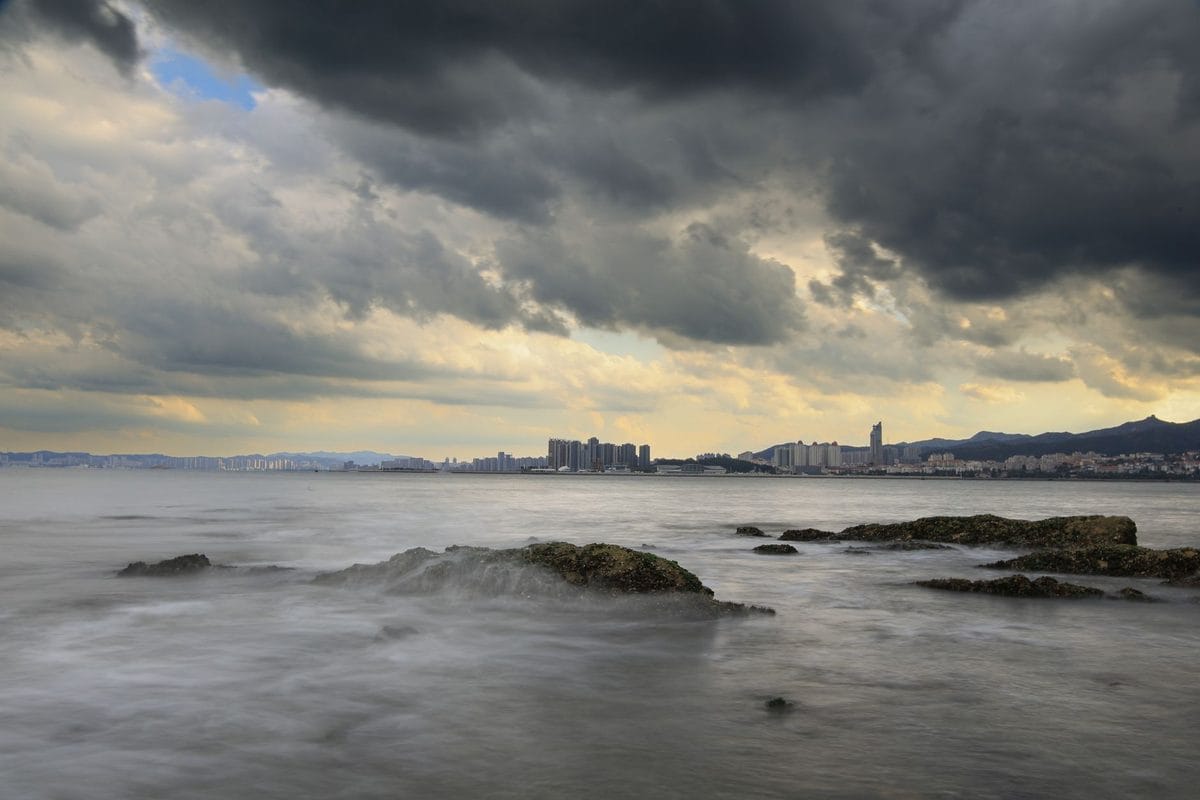
Fourteen typhoons formed over the northwest Pacific in July and August this year, tying the record for those two months, according to Taiwan's Central Weather Administration (CWA), against a normal of 9.3. In a typical year the same agency expects another 10 to 12 between September and November, so anyone who moved to Asia in the past twelve months is probably heading into a first autumn of storm alerts. Every country has its own warning system, with its own numbers and its own answer to who decides whether you go to work. The numbers do not translate: a No. 3 signal in Hong Kong means strong winds within about 12 hours, a Level 3 in Japan means vulnerable residents should start leaving, and a Wind Signal #3 in the Philippines means winds of 89 to 117 km/h within 18 hours.
October Is Still Inside the Season
October is not the off-season anywhere on this list.
Japan's Meteorological Agency counts about 25 typhoons forming in an average year, about 12 passing within 300 kilometers of the country and about 3 making landfall. Its 1991–2020 normals for October alone are 3.4 formations, 1.7 approaches and 0.3 landfalls, fewer than in August or September (3.3 approaches each), yet NHK's disaster-prevention series still opens with the reminder that typhoons threaten Japan "especially in October." PAGASA, the Philippine weather agency, puts the peak of its season at July through October, when nearly 70 percent of typhoons develop. The CWA adds a nuance for Taiwan: with El Niño strengthening, it expects the number of storms affecting the island this autumn to be normal to below normal. That is a seasonal count, not a promise about any single week, and the agency flags that an autumn typhoon arriving alongside the northeast monsoon can bring heavy rain to northern Taiwan, where Taipei sits.
Hong Kong: Signal 8 Is the One That Changes Your Day
The Hong Kong Observatory uses five numbers: No. 1 (Standby), No. 3 (Strong Wind), No. 8 (Gale or Storm), No. 9 (Increasing Gale or Storm) and No. 10 (Hurricane). For work, only No. 8 and above really matter. The Observatory issues a Pre-No. 8 Special Announcement within the two hours before the signal takes effect, which is the cue for offices to release staff in batches, with people who have mobility problems, depend on ferries or live on outlying islands going first. The Labour Department revised its Code of Practice for adverse weather and "extreme conditions" on May 4, 2026, and the text is blunt about what employers should not do: deduct wages, a good-attendance bonus or allowances because you could not get to work, make you compensate for the lost hours later, or cut annual leave or rest days to offset them. If your employer needs you on site while public transport is suspended or limited at No. 8 or above, the code says it should provide safe transport or an additional travelling allowance. The Employees' Compensation Ordinance also covers injuries on the direct route between home and work, within four hours before or after working hours, on days when No. 8, a Red or Black Rainstorm Warning or extreme conditions are in force.
Black rainstorms and "extreme conditions" work differently from typhoon signals. During a Black Rainstorm, indoor staff keep working unless it is dangerous while outdoor duties stop, and after a government extreme-conditions announcement anyone who has not agreed in advance to report should stay where they are instead of heading out. The code is written mostly as "should," and it leaves the number of hours you have to resume work after a signal comes down to whatever you and your employer agreed beforehand. Get that agreement in writing before the first No. 8 of the season, and ask whether remote work is part of it.
Taiwan: Your County Government Decides, Not the Forecast
The CWA issues the typhoon warnings, but a typhoon day (the work and class suspension people call 颱風假) is announced separately by each county or city government, so one city can close while the next keeps working. That matters because the Ministry of Labor's guideline protects you in three situations: the local government where you work has announced a suspension, the one where you live has, or the one covering the only route you can take to work has. In any of those cases, your employer may not treat the absence as lateness, force you onto personal leave, demand a make-up day, withhold a full-attendance bonus or dismiss you. The same protection applies if typhoon traffic makes you late even though no suspension was announced.
Pay is the softer part. A typhoon day is not a statutory holiday under the Labor Standards Act, and the ministry's position is that employers are advised not to deduct wages, so in practice your pay depends on your contract and company policy. If your employer does call you in, the guideline calls for extra pay on top of the day's wage plus transport help, and the ministry has said employers who require attendance must cover extra commuting costs, such as a taxi when buses are not running. Complaints go to the local labor authority or the ministry's 1955 hotline, and the live list of which counties are closed sits on the Directorate-General of Personnel Administration's "Work and Class Status During Natural Disasters" page.
Japan: The Alert Levels Changed in May
On May 29, 2026, the Japan Meteorological Agency switched to a rebuilt alert scheme. Warnings for river flooding, heavy rain, landslides and storm surge now come in five numbered levels, 1 Early Advisory (white), 2 Advisory (yellow), 3 Warning (red), 4 Urgent Warning (purple) and 5 Emergency Warning (black), and the numbers line up with the evacuation calls local governments issue. At Level 3, people who need more time, such as older residents, are urged to start leaving, and at Level 4 everyone in the danger area should evacuate. By Level 5 a disaster may already be underway, which is why the agency's own leaflet says to evacuate by Level 4. Strong-wind and high-wave warnings sit outside the five-level scheme.
The first test came within days. Typhoon Jangmi triggered a Level 5 emergency warning for river flooding in Wakayama Prefecture and Level 4 urgent warnings in 11 prefectures, and the Mainichi's editorial afterward noted that some announcements were delayed by a malfunction in the agency's system. That is a fair reason not to depend on a single source. Install the Safety tips app supervised by the Japan Tourism Agency, which pushes alerts in 15 languages, bookmark JMA's KIKIKURU risk map for color-coded risk at your exact location, and look up your ward's hazard map before the first approach. If you live on a ground floor, NHK suggests agreeing in advance to shelter with neighbors on higher floors, and it points out that a public shelter is not the only option, since a friend's place in a low-risk area or a hotel counts too.
Trains catch newcomers out. Japanese railways often announce a planned suspension (keikaku unkyū) one to two days ahead of a typhoon, stopping service before the worst weather arrives instead of during it, so a commute that works at 5 p.m. may not exist at 7 p.m. Japan has no government-declared typhoon day, so whether your office closes is your employer's call. Under the Labor Standards Act a closure that is the employer's responsibility requires at least 60 percent of average wages, while a genuine force majeure closure does not, and that gray area is worth asking HR about before the storm rather than during it. Your renter's fire insurance (kasai hoken), which most leases require, lists windstorm among covered perils, but check that flood damage is included in your plan too.
The Philippines: Five Wind Signals That Can Skip Steps
PAGASA's Tropical Cyclone Wind Signals, in use since March 23, 2022, run from #1 to #5 and are tied to expected wind speed and lead time. Signal #1 means winds of 39–61 km/h within 36 hours, #2 means 62–88 km/h within 24 hours, #3 means 89–117 km/h within 18 hours, #4 means 118–184 km/h within 12 hours, and #5 means 185 km/h or more, also within 12 hours. A locality can jump from #1 straight to #3 without passing through #2, signals are usually raised for whole provinces or cities, and Metro Manila is placed under a single signal level as a block. The scale measures wind only, so it says nothing directly about flooding rain, and with PAGASA putting the average at about 20 typhoons a year, a Signal #1 is a prompt to check the rain forecast rather than a reason to relax.
Four Systems at a Glance
| Place | Agency | Scale | Check here |
|---|---|---|---|
| Hong Kong | Hong Kong Observatory | Signals No. 1, 3, 8, 9, 10 | MyObservatory app |
| Taiwan | Central Weather Administration | Typhoon warnings; closures set by each county or city | DGPA "Work and Class Status" page |
| Japan | Japan Meteorological Agency | Alert Levels 1–5, white to black | Safety tips app, KIKIKURU map |
| Philippines | PAGASA | Wind Signals #1–#5 | PAGASA cyclone bulletins |
What to Do Before the Signal Goes Up
Buy water and food one to two days ahead, not on the day. NHK points out that going outside becomes dangerous once the rain intensifies and that distribution networks may be disrupted, so what you want may not be on the shelf.
- Water: the Tokyo Metropolitan Government's stockpile guidance is 3 liters per person per day, for at least three days and ideally seven.
- Outside your door: bring in laundry poles, bicycles, flower pots and trash cans, and clear leaves from drains before the rain starts.
- Your address, because a river that floods and a slope behind the building call for completely different responses, so find the hazard map and write down the nearest evacuation point.
- Portable radio, flashlight, batteries, medication and toilet paper, among other items on NHK's list.
If you have flights booked, keep in mind that insurers generally treat a named storm as a known event, so a travel policy bought after the storm is named will usually exclude it. The time to buy cover is when you book.
Pick the section above that matches your city, install the app named in it tonight, and send your landlord and your HR contact the same short message: what is the plan when the signal goes up, and who tells me?